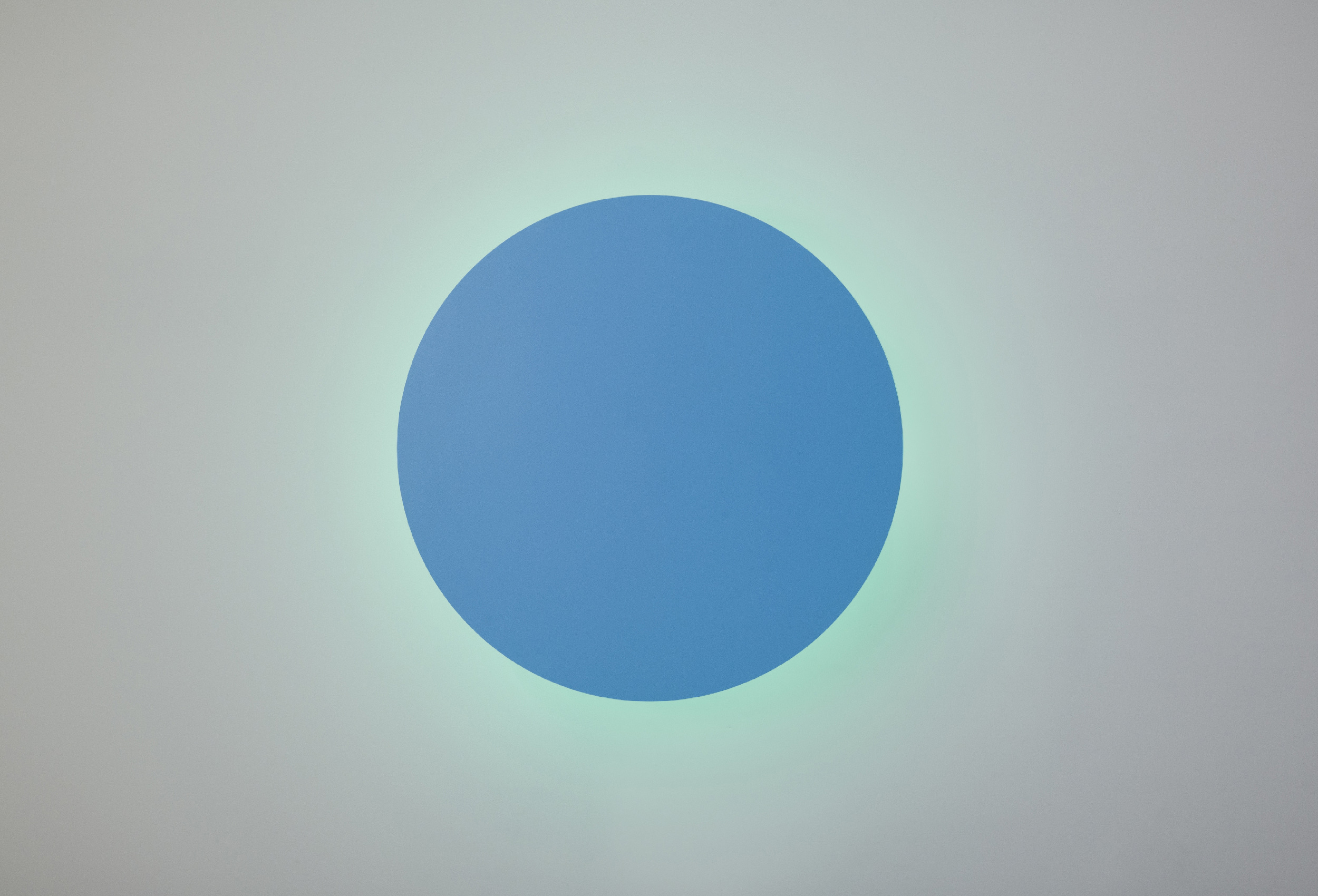
Farbige Sonne Grün-RotMdf, Lack, Stahl, LED 150 x 150 x 30cmOpenSpace, Berlin, 2026
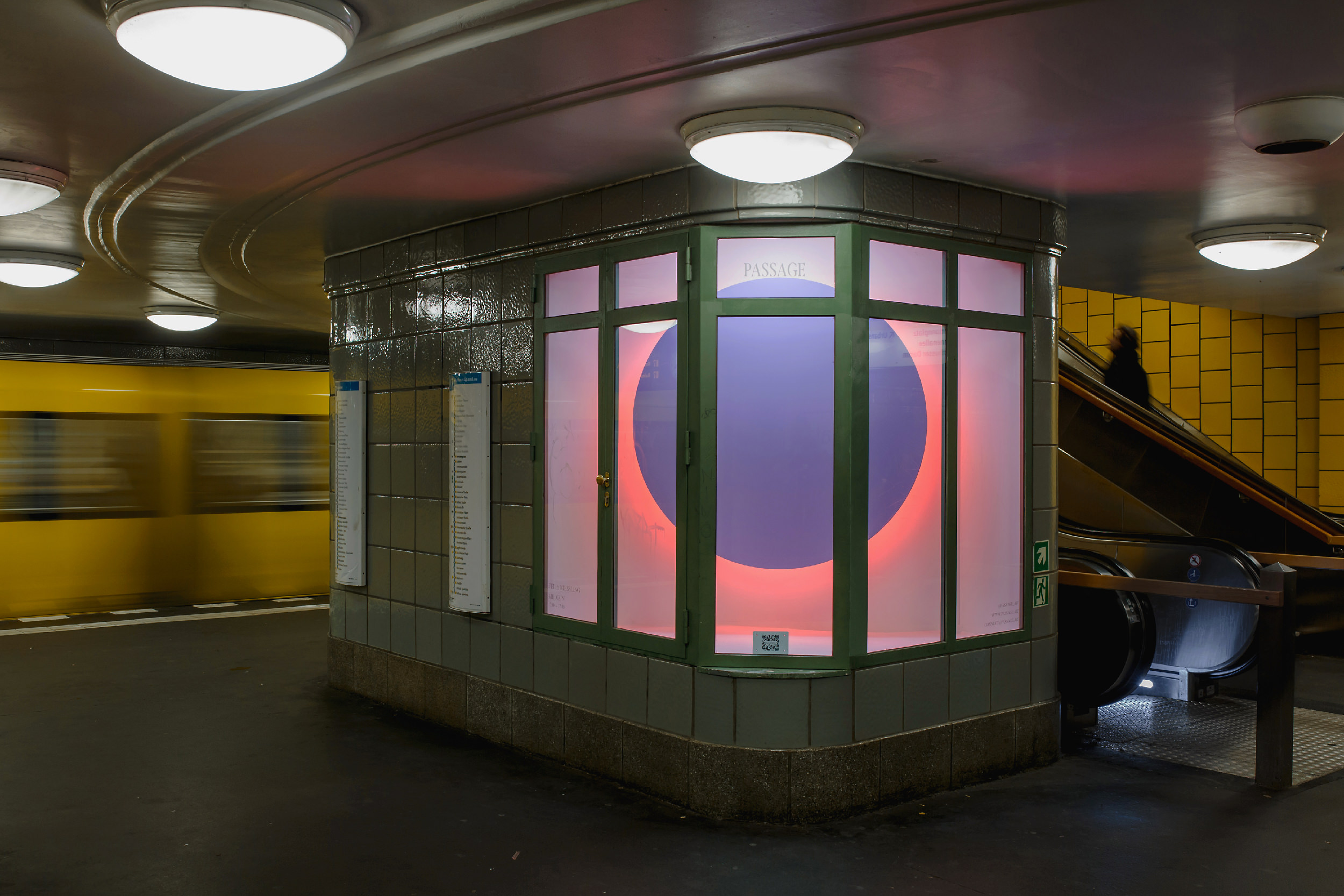
Lila Sonne
Mdf, Lack, Stahl, LED 138 x 138 x 30 cmPassage Art, Berlin, 2025Foto: Fabian Brennecke
The Unstable Edge of VisionFakewhale editorial Team, 2025 / excerpts & editedFelix Kiessling, with Farbige Sonnen (series 2023–2025), invites us into a confrontation with perception itself. At first glance, the works seem simple: monochromatic circles suspended on a neutral wall, stark in their minimalism. Yet, as you stand before them, something unsettling happens. The color detaches from the surface, not in a literal sense, but in the way it radiates, vibrates, and seems to extend beyond its own boundaries. A soft halo of light surrounds each form, creating a perceptual ambiguity.What is real, and what is illusion? Is the glow an actual physical effect, or a trick of the eye? Is this just paint on a wall, or has Kiessling managed to make color itself into an object, a presence hovering in space? These are not just paintings, nor are they merely optical illusions. They exist in an in-between state, where materiality and perception dissolve into one another.Compared to his earlier work Antisonne, a black circle that could be read as a void, a rupture, or even a representation of absence, these colored versions push further toward pure experience. Kiessling refers to them as an “enhanced reduction”, a term that encapsulates their paradoxical nature. The less there is, the more we see. By stripping away any explicit reference or representation, he allows color to exist in its most elemental and immersive form. The color of Farbige Sonne is not just a hue, it is a density, a field of energy that seems to stretch beyond the confines of the wall. It doesn’t sit passively on the surface but instead exerts a kind of gravitational pull, inviting the viewer to fall into its depth. Farbige Sonne does not simply present the color, it embodies it. It takes on an almost biological presence, as if it were a living force rather than mere pigment. It pulses softly against the wall, appearing at once material and immaterial, fixed yet fluid.These works do not tell a story. They do not symbolize anything. And yet, they generate an undeniable emotional and physical response. Kiessling shifts our attention from what we are looking at to the act of seeing itself. Where does the artwork end, and perception begin? How much of what we experience is dictated by the object, and how much by the way our minds process reality? Farbige Sonnen demand that we engage not just with them, but with the limits of our own perception.In this way, Kiessling’s work belongs to a long tradition of artists who explore the fundamental nature of vision and reality, yet he does so with an almost scientific precision. His approach is not about abstraction in the traditional sense, it is about creating conditions for a specific kind of encounter, one where the viewer becomes acutely aware of the interaction between light, space, and their own presence in the room.These are not just circles. They are thresholds, portals into an experience that is as much about what is physically present as it is about what is felt, sensed, and intuited. Farbige Sonnen are not objects to be understood, but phenomena to be lived. In their stark simplicity, they invite a radical confrontation with the act of seeing itself.
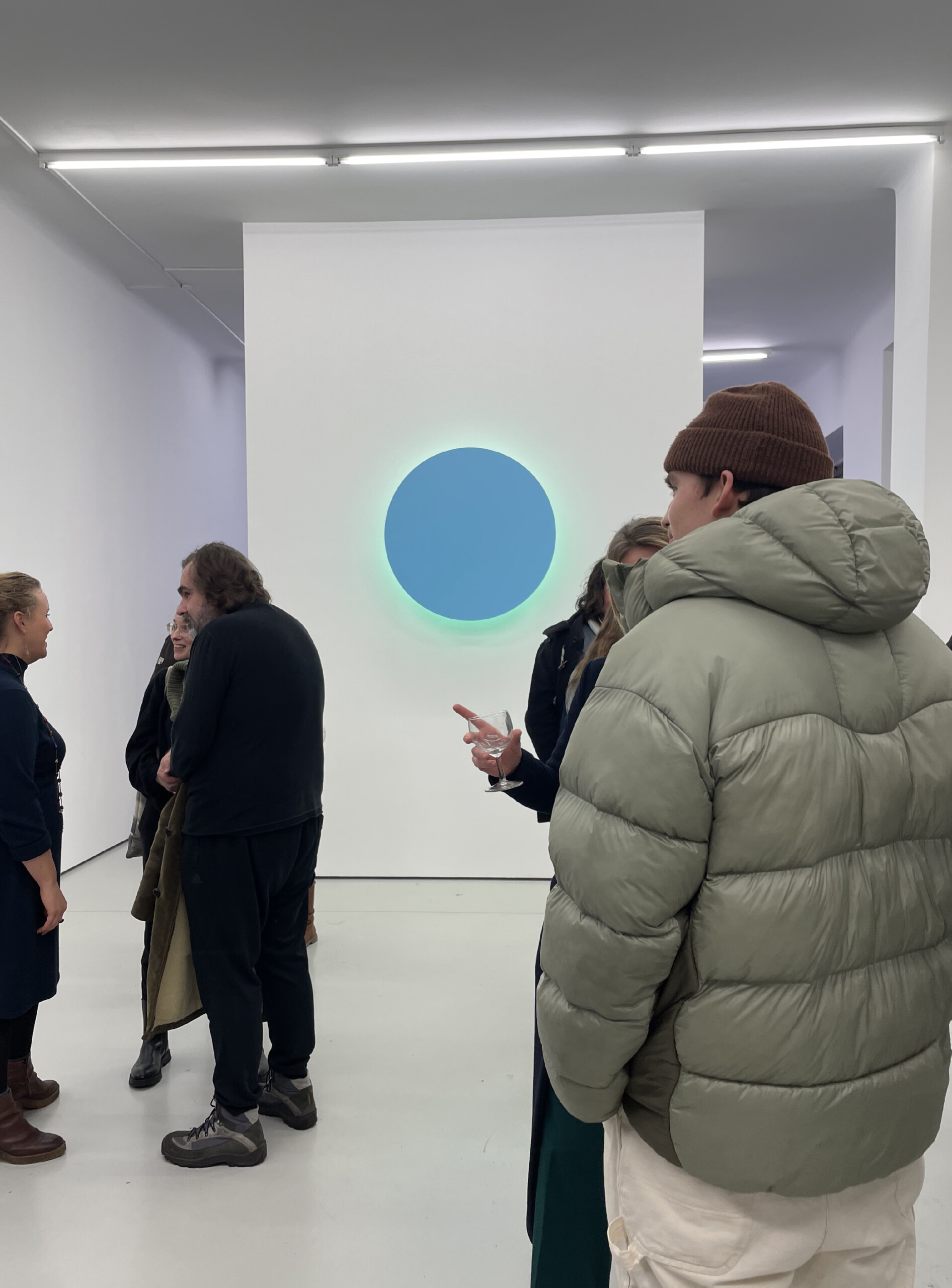
Blaue Sonne, 2023
Mdf, Lack, Stahl, LED 100 x 100 x 30 cm
Grüne Sonne, 2023 at Quitte Eisen Soda, Kunstverein Heilbronn, 2023
Mdf, Lack, Stahl, LED 150 x 150 x 40cm
Blaue Sonne 2022, mdf, metal, varnish, leds, 100x100x30cmOxytocin, Eins, Limassol, Cyprus 2022, www.einsgallery.com
Farbe ohne Raum. Renaissance taught you you’re in control, but you ain’t.
Fotos: Mirka Koutsouri
(EN)A circular shaped object is coated with mat blue lack. Red lights are installed behind. Blaue Sonne is positioned within our reach and mesoscopic scale, yet appears to have neither scale nor material.
Blaue Sonne creates a cognitive visual irritation in space, a small excerpt of nothingness, a window to a space we feel but cannot fathom. It could be a hole through which we see the sky, it could be a convex shape coming towards us. Kiessling argues, this exact moment, when things don‘t fully make sense, offers the chance to glimpse into a more objective reality – beyond the way we are used to process, construct and make sense of reality and the world surrounding us.Compared to its black predecessor Antisonne, which could be seen and understood as a hole, Kiessling argues, this colored version is a heightening of its analytical abstraction. Blaue Sonne is further liberated from expression and representation and thus enjoys a deeper meditative freedom and innocence.
(DE)Ein kreisförmiges Objekt ist mit mattblauem Lack überzogen. Dahinter sind rote Lichter installiert. Blaue Sonne ist in unserer Reichweite und mesoskopischen Skala positioniert, scheint aber weder Maßstab noch Material zu haben.Blaue Sonne schafft eine kognitive visuelle Irritation im Raum, einen kleinen Ausschnitt des Nichts, ein Fenster zu einem Raum, den wir spüren, aber nicht ergründen können. Es könnte ein Loch sein, durch das wir den Himmel sehen, es könnte eine konvexe Form sein, die auf uns zukommt. Kiessling argumentiert, dass genau dieser Moment, in dem die Dinge keinen vollständigen Sinn ergeben, die Chance bietet, einen Blick auf eine objektivere Realität zu werfen - jenseits der Art und Weise, wie wir gewohnt sind, Realität und die Welt um uns herum zu verarbeiten, zu konstruieren und ihr einen Sinn zu geben.Im Vergleich zu seinem schwarzen Vorgänger Antisonne, der als Loch gesehen und verstanden werden könnte, so Kiessling, bedeutet die farbige Version eine Steigerung in seiner ihrer analytischen Abstraktion. Die Blaue Sonne ist weiter von Ausdruck und Darstellung befreit und genießt dadurch eine tiefere meditative Freiheit und Unschuld.
'Blaue Sonne, blue sun, plays with the common optics of what can be perceived to be the sun or an eclipse of the sun. Red shades highlight a clear blue to create an object that mystifies and inverts its own proximity and depth.' Chloe Stavrou